While you are Looking for AI Watch Out for RedLine Malware
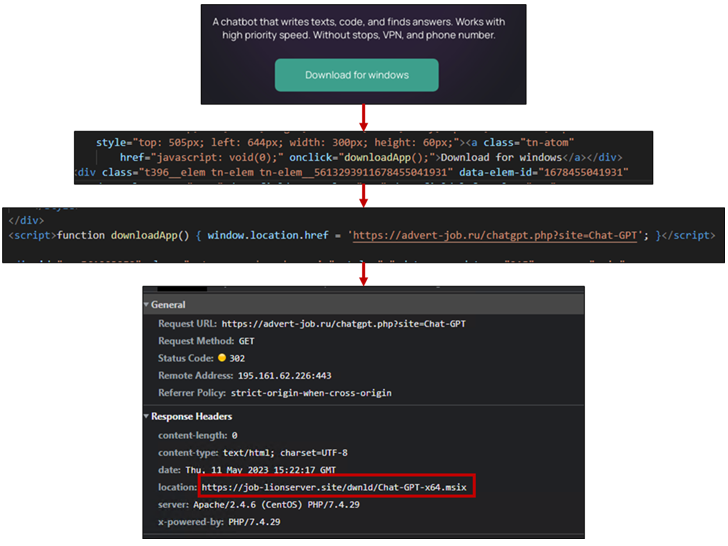
Malicious Google Search ads for generative AI services like OpenAI
ChatGPT and Midjourney are being used to direct users to sketchy
websites as part of a BATLOADER campaign designed to deliver RedLine Stealer malware.
"Both AI services are extremely popular but lack first-party
standalone apps (i.e., users interface with ChatGPT via their web
interface while Midjourney uses Discord)," eSentire said in an analysis.
"This vacuum has been exploited by threat actors looking to drive AI app-seekers to imposter web pages promoting fake apps."
BATLOADER is a loader malware that's propagated via drive-by
downloads where users searching for certain keywords on search engines
are displayed bogus ads that, when clicked, redirect them to rogue
landing pages hosting malware.
The installer file, per eSentire, is rigged with an executable file
(ChatGPT.exe or midjourney.exe) and a PowerShell script (Chat.ps1 or
Chat-Ready.ps1) that downloads and loads RedLine Stealer from a remote
server.
Once the installation is complete, the binary makes use of Microsoft Edge WebView2
to load chat.openai[.]com or www.midjourney[.]com – the legitimate
ChatGPT and Midjourney URLs – in a pop-up window so as to not raise any
red flags.
The adversary's use of ChatGPT and Midjourney-themed lures to serve
malicious ads and ultimately drop the RedLine Stealer malware was also highlighted last week by Trend Micro.
This is not the first time the operators behind BATLOADER have
capitalized on the AI craze to distribute malware. In March 2023,
eSentire detailed a similar set of attacks that leveraged ChatGPT lures to deploy Vidar Stealer and Ursnif.
The cybersecurity company further pointed out the abuse of Google
Search ads has fallen off from their early 2023 peak, suggesting that
the tech giant is taking active steps to curtail its exploitation.
The development aligns with a broader wave of phishing and scam campaigns,
wherein threat actors are attempting to cash in on the surging use of
these AI tools to distribute malware and other bogus apps.
Security vendor Sophos, in a related research, outlined a set of ChatGPT-related fleeceware apps
in the Google Play and Apple App Store — collectively dubbed FleeceGPT –
that coerce users into signing up for unwanted subscriptions.
"Because fleeceware applications are designed to stay on the edge of Apple and Google terms of service
and do not access private information or attempt to circumvent platform
security, they are rarely rejected during review and are allowed into
the app stores," Sophos researchers Jagadeesh Chandraiah and Sean
Gallagher said.
In recent weeks, both Meta and Palo Alto Networks Unit 42 have warned
of increasing fraudulent activity mimicking the ChatGPT service to
harvest users' credit card details, perpetrate credit card fraud, and
copycat chatbot browser extensions that steal victims' Facebook account
details.
Between November 2022 through early April 2023, Unit 42 said it
detected a 910% increase in monthly registrations for domains related to
ChatGPT.
The findings come weeks after Securonix uncovered a phishing campaign dubbed OCX#HARVESTER that targeted the cryptocurrency sector between December 2022 and March 2023 with More_eggs (aka Golden Chickens), a JavaScript downloader that's used to serve additional payloads.